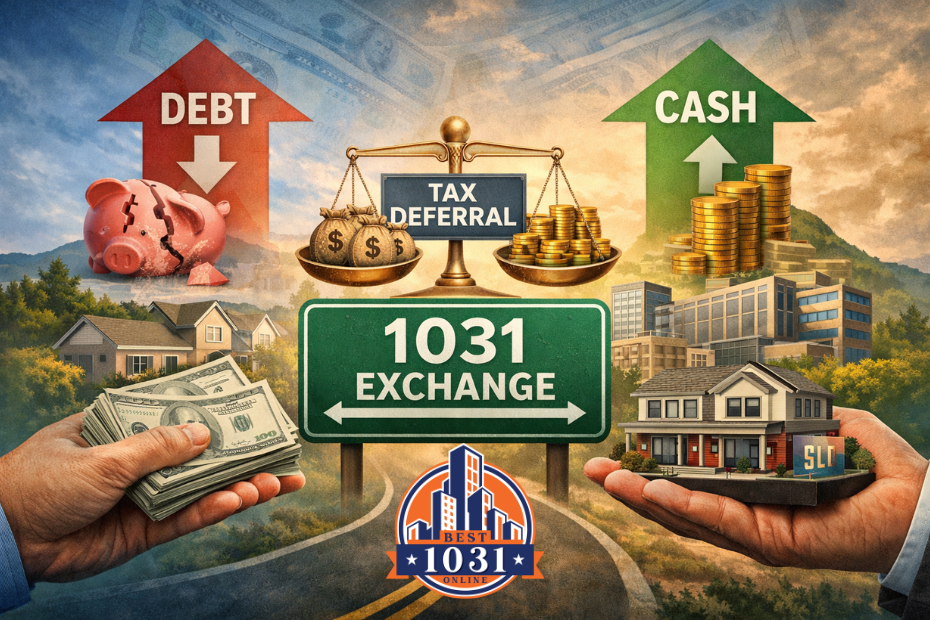
How to Fully Defer Taxes the Right Way
In my experience working with investors across the country, one of the most common and costly misunderstandings I see in a 1031 Exchange revolves around debt.
Many taxpayers, and even some tax advisors, believe that the IRS requires you to take on equal or greater debt on your 1031 Exchange replacement property in order to fully defer taxes.
That is simply not the rule.
And if you are making decisions based on that assumption, you may be limiting your options, increasing your risk, and missing better investment opportunities.
Let’s walk through this the right way.
1031 Exchange Rules: It’s Not About Replacing Debt. It’s About Replacing Value
When you sell your relinquished property in a 1031 Exchange, the IRS is not focused on whether you replace your loan with another loan.
What matters is that you replace the total value of what you sold.
The Equal or Greater Value Rule
To achieve full capital gains tax deferral, you must:
- Purchase replacement property of equal or greater value
- Reinvest all net proceeds from the sale
- Replace the value of any debt that was paid off
This is where confusion around 1031 Exchange debt replacement typically begins.
Because yes, debt matters.
But not in the way most people think.
Can You Replace Debt with Cash in a 1031 Exchange? Yes. Here’s How
This is one of the most searched questions online:
Do you have to replace debt in a 1031 Exchange?
Can you replace debt with cash in a 1031 Exchange?
The answer is yes. You can replace debt with cash.
Understanding Debt Replacement vs. Value Replacement
When you sell your property, any existing loan is paid off at closing. The IRS views that payoff as debt relief.
If you do not offset that debt relief, it can result in mortgage boot, which is taxable.
Here is the key:
- You do not have to replace that debt with new financing
- You do have to replace the value of that debt
Example: How to Avoid Boot in a 1031 Exchange
Let’s make this simple and practical.
You sell a property for $3 million
- Debt paid off: $1 million
- Net proceeds: $2 million
To fully defer taxes, you must acquire replacement property worth $3 million or more.
Option 1: Replace Debt with Debt
- $2M exchange proceeds
- $1M new loan
Option 2: Replace Debt with Cash
- $2M exchange proceeds
- $1M additional cash
Both scenarios satisfy IRS 1031 Exchange rules.
Both allow you to avoid boot in a 1031 Exchange.
Both achieve full tax deferral.
What Happens If You Do Not Replace Debt in a 1031 Exchange?
If you fail to replace the value of the debt, either through new financing or cash, you create mortgage boot, which becomes taxable.
This is why understanding 1031 Exchange boot is critical.
Key Takeaway
- It is not about the loan
- It is about the gap in value
If there is a gap, the IRS taxes it.
Why This Strategy Matters for Real Estate Investors
This is where things get interesting and where strategy comes into play.
I work with a lot of long-term property owners, people who have held assets for 10, 15, even 20+ years.
At this stage, most are not looking to take on more complexity or risk.
They are looking to:
- Simplify their portfolio
- Reduce management responsibilities
- Preserve wealth
- Improve quality of life
This is exactly where understanding 1031 Exchange debt versus equity requirements becomes a game changer.
More Flexibility Means Better Investment Decisions
When you realize you can replace debt with cash, you can:
- Reduce or eliminate leverage
- Move into passive real estate investments
- Target hands-off replacement properties
- Improve cash flow stability
- Align your investments with long-term lifestyle goals
This is especially powerful when transitioning into assets like absolute net leased properties, where the tenant is responsible for everything and the income is designed to be predictable.
1031 Exchange Planning Strategies: Why Most Investors Get This Wrong
Here is the reality.
Most investors do not learn these rules until they are already in the middle of their exchange.
At that point:
- The 45-day clock is ticking
- Pressure is high
- Options feel limited
That is when mistakes happen.
The Right Approach
The most successful exchanges happen when:
- You understand the rules before you sell
- You identify replacement strategies early
- You work with a 1031 Exchange real estate broker who understands both the rules and the market
Because this is not just a tax strategy.
It is an investment strategy.
Final Thought: Replace Value, Not Debt
If you take one thing away from this, let it be this:
You do not need to replace debt with debt in a 1031 Exchange.
You need to replace value to fully defer taxes.
That distinction gives you control.
It gives you flexibility.
And it opens the door to better, more strategic investment decisions.
Work With a 1031 Exchange Expert
As a commercial real estate broker specializing in 1031 Exchange replacement property, I work directly with investors to identify, negotiate, and acquire the right assets to complete their exchange successfully.
From sourcing opportunities nationwide to structuring the transaction, my role is to help you:
- Avoid costly mistakes like boot
- Understand IRS 1031 Exchange rules
- Find the right replacement property
- Execute a strategy that aligns with your long-term goals
Because a successful 1031 Exchange is not just about deferring taxes. It is about making a smarter investment with what you have built.
Stay Connected with Best 1031 Online!
Want more insights on 1031 Exchanges, real estate strategies, and smart planning to preserve both wealth and family harmony?
Subscribe to my YouTube channel, Best 1031 Online!, where I release monthly episodes of QI Corner and other expert content designed to keep you informed and ahead of the curve.
Subscribe to Best 1031 Online!
I cannot do this alone!
This Channel would not exist if it weren’t with the daily support of CRE Task Wizard!
Go visit CRE Task Wizard at https://cretaskwizard.com/ to see how they can get you doing what you are best at, doing deals!
Please stay tuned and follow me on LinkedIn, X, Instagram, TikTok & Facebook @1031BrokerJames.
All information is deemed to be accurate and is not tax or legal advice. All investors/taxpayers should consult their CPA, tax attorney and investment advisors.
All information is deemed to be accurate and is not tax or legal advice. All investors/taxpayers should consult their CPA, tax attorney and investment advisors.