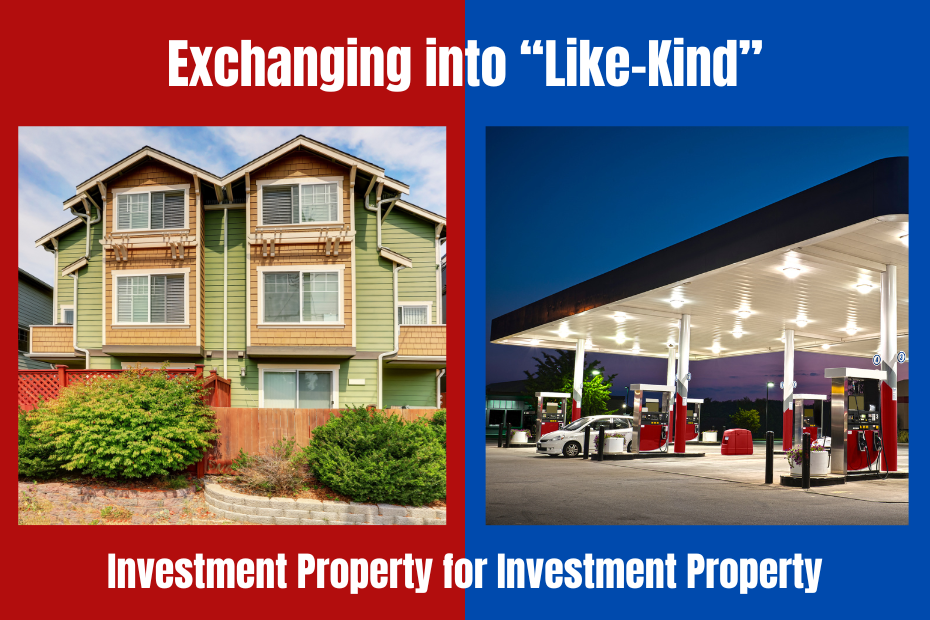
One of the most common misconceptions I hear about the 1031 exchange from more senior investors is that the term “like-kind” makes them think that they must exchange into the exact same type of property that they are selling. This misunderstanding has prevented many of these investors from fully leveraging the power of a 1031 exchange, which in turn has caused them to own their properties for much longer than they should have. The truth is, the IRS defines “like-kind” much more broadly, allowing for significant flexibility in reinvesting sale proceeds from a sold property into a replacement property.
In this article, we will break down what “like-kind” really means and how investors can maximize their wealth-building opportunities under Section 1031 of the Internal Revenue Code.
What Does “Like-Kind” Actually Mean?
Under the Internal Revenue Code, “like-kind” refers to the nature or character of the property rather than its specific type or use. Any real property held for investment or business purposes can be exchanged for another real property that is also held for investment or business purposes. The IRS is surprisingly flexible in this regard if the properties involved are real estate and are not held primarily for personal use.
Examples of “Like-Kind” Exchanges That Work
To illustrate just how flexible the “like-kind” standard is, here are a few examples of allowable exchanges (keep in mind that these are simple examples; you can interchange any of these examples):
- Vacant Land for a Commercial Building – An investor selling a parcel of vacant land can exchange into an income-producing office building.
- Multifamily for a Net Leased Property – A seller of an apartment complex can exchange into a single-tenant, net leased property, where more than a dozen uses could be their tenant.
- Industrial Warehouse for a Self-Storage Facility – A logistics company selling a warehouse could exchange into a self-storage facility to diversify their portfolio.
- Hotel for a Medical Office Building – A hotel operator who wants to exit the hospitality business could reinvest into a medical office building leased to long-term tenants.
- Residential Rental for Raw Land – A landlord selling a residential rental property could acquire undeveloped land for future appreciation or development.
As these examples show, investors have a wide range of options when selecting a replacement property. The requirement is simply that both the relinquished and replacement properties are held for productive use in a trade, business, or for investment.
What You Cannot Exchange Under 1031
While the IRS provides a broad interpretation of “like-kind,” there are some clear limitations. For example:
- You cannot exchange real estate for personal property (e.g., selling an apartment complex and acquiring a yacht or artwork).
- You cannot exchange dealer inventory (e.g., flipping houses does not qualify for 1031 treatment because the properties are considered inventory rather than investments).
- You cannot exchange real estate for partnership interests or shares in an entity that owns real estate (like a REIT).
How This Flexibility Benefits Investors
Understanding the true meaning of “like-kind” in 1031 exchanges provides real estate investors with greater freedom and strategic flexibility. It allows investors to diversify their portfolios, move into different asset classes, and adjust their holdings based on market conditions and investment goals. For example:
- Investors looking for less management responsibility can exchange from a hands-on apartment complex into a net leased property, where the tenant is 100% responsible for the maintenance, all the operating expenses and overall management.
- Those seeking higher income potential can shift from vacant land into an income-producing commercial property.
- Investors aiming for geographic diversification can sell property in one state and exchange into another, so long as both are within the U.S.
Final Thoughts
The myth that “like-kind” means “exactly the same” has misled many investors and, in some cases, caused them to miss out on valuable opportunities. The reality is that 1031 exchanges are far more flexible than many realize, allowing investors to transition from one type of investment property to another in a way that best suits their financial goals.
If you have been holding off on a 1031 exchange because you thought you had to replace your property with something identical, it is time to reconsider.
We Are Here to Help!
If you are an investment property owner who is interested in a no obligation, private consultation, please visit www.Best1031Online.com, or contact James Bean
of SVN-Rich Investment Real Estate Partners, CA DRE# 01970580, at 805-779-1031
or email at [email protected].
If you are an agent/broker, I am happy to discuss strategies with you on how to best serve your next listing client in preparing them for a successful exchange. Please visit the site and click on the Agent’s button located at the top right-hand corner of the Home Page!
Don’t know what certain terms mean?
Click here for a Glossary of Terms: https://svn-best1031online.com/glossary/
Want more on the 1031 Exchange?
Come join me on my YouTube Channel “Best 1031 Online”
The ONLY channel 100% dedicated to all things 1031!
And visit CRE Task Wizard at https://cretaskwizard.com/, who supports me in making the channel happen.
Please stay tuned and follow me on LinkedIn, X (formerly known as Twitter), Instagram, & Facebook @1031BrokerJames.
All information is deemed to be accurate and is not tax or legal advice. All investors/taxpayers should consult their CPA, tax attorney and investment advisors.